
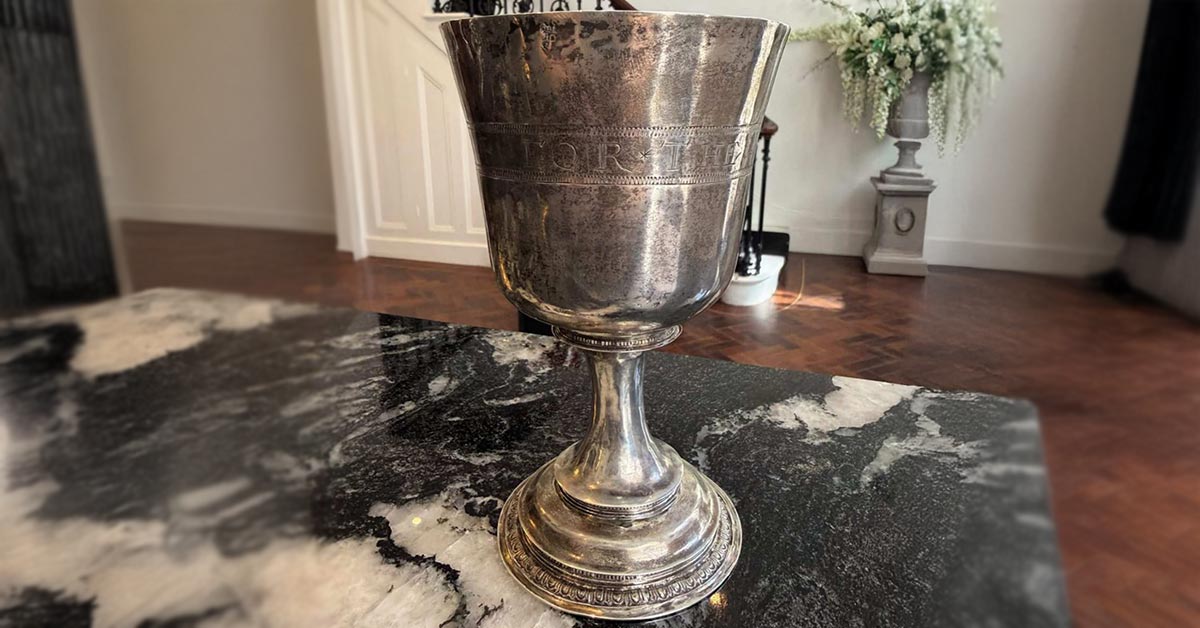
A remarkably rare Elizabethan silver chalice, traced to a Norfolk church and verified through historic records, reveals the enduring fascination of antique silver.
Another unique object came our way recently, this time in the form of a very rare silver church communion chalice or goblet. Initially it looks like any other ordinary chalice or wine goblet but on closer inspection the primary indication of the age of the object is given away by the blue tint of the silver. Immediately I realised this is certainly not any ordinary chalice.
Having made a very quick initial inspection of the silver chalice I could immediately make an educated assessment of the age and period of it – I was hoping it was from the Elizabethan period 1558 to 1603. During this initial glance I noticed the hallmarks. I asked the potential seller if he would kindly leave the chalice with me while I conducted a more defined inspection.
The extra time gave me the opportunity to do a bit more research into the chalice. Following a confirmatory check with the Jackson’s Hallmarking guide book, and some research online, I then went in search of confirmatory trade expertise of my initial assessment. Several of our trade contacts in both Birmingham’s Jewellery Quarter and London’s Silver Vaults, (whom I consult with regularly as I deem them true silver experts) confirmed to me that the chalice hallmarks were indeed genuine. I now had in my hands a period Elizabethan church chalice.
The hallmarks however brought about another question? How was the object obtained? Knowing all chalices of the Elizabethan period bearing the Norwich Assay office hallmark were all accounted for and documented in the Norfolk Records Office (NRO) and in particular by Colin Ticktum’s Norwich Silver reference book. When the owner returned I asked him the question and he explained it was purchased through an auction house in 2011, and all salient provenance and documentation was accompanied with the silver chalice. I was very intrigued, and very eager to say the least, to obtain such a rare object for our window display.
The chalice itself is hand engraved in a very old font or text. Inscribed throughout the principle middle section of the chalice’s circumference is the dedication ‘For the Tovne of Antyngham’. Weighing 223.8 grams and measuring 15.5cm high, the chalice bears the silver hallmark of the lion surmounted by the castle revealing that it was assayed through the Norwich assay office, thus making it a very rare object.
Our chalice is dated between 1565 to 1569. It also has the marks of the sun in its splendour enhancing the provenance of the maker’s stamp or mark of Peter Peterson I who was commissioned to make a few chalices for various Norfolk churches. The records of both the NRO and the Tickcum reference book confirm that the chalice was located at the St Mary’s Church in Antingham.
St Mary’s Church is a ‘doublet church’ which is when two churches share the same churchyard – an interesting fact, but not unique or unusual for a medieval churchyard – these being the two churches of St Mary’s and St Margeret’s. It is believed the original church dates back to the 12th century.
We specialise in many unique silver items and if anyone requires a valuation or wants to sell any silver object, we are here to assist you. Simply drop by the store Tuesday to Saturday for a free valuation.