
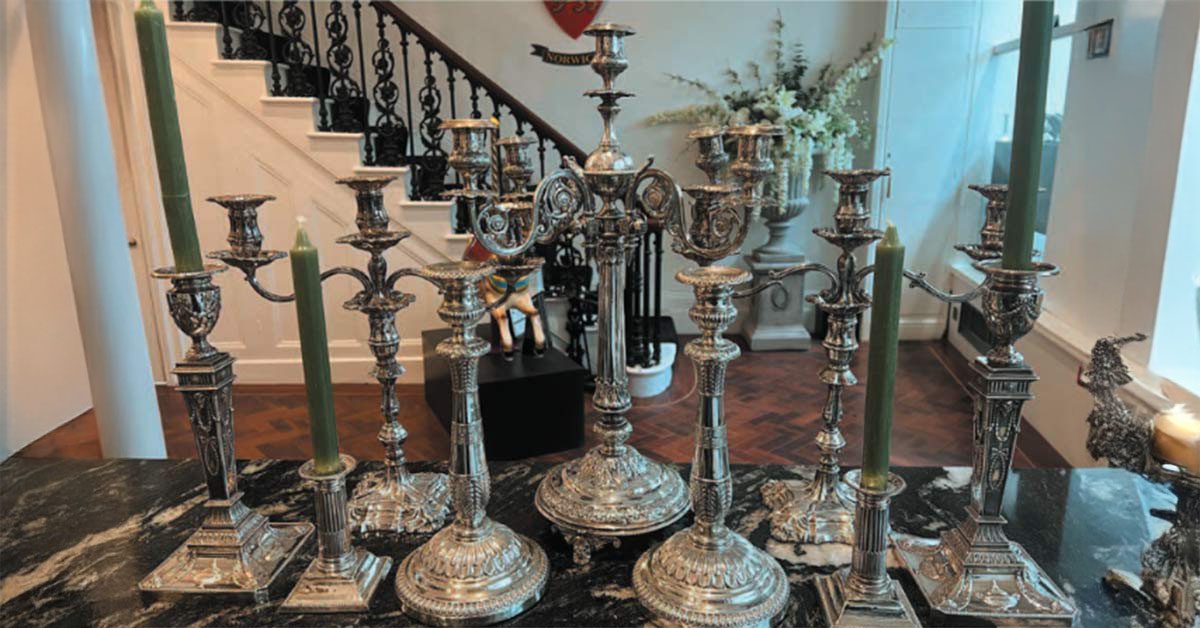
From ancient symbolism to elegant centrepieces, the candelabrum has illuminated history in both sacred and social settings. Juels’ Limited explains more.
For centuries the candelabrum (plural for candelabra) can also be used in its singular form to describe a variety of candle holders. The term candelabra is usually distinguished by a branched candle holder that is placed on a surface such as the floor, stand, or tabletop.
Candelabra were known to have been used in the ancient world. A notable example is the seven-armed candelabrum or menorah, mentioned in the Hebrew Bible with instruction on its creation to Moses. The menorah is depicted in the Arch of Titus following the capture of Jerusalem. In Judaism, the menorah and hanukkiah are special kinds of candelabra and have since become a symbol of Judaism and an emblem of Israel.
The Romans used the term to describe a form of ornamental lighting, which may be a tall stand that supports a lamp forming ornamental lighting to specific areas of note. Examples have been found in Pompeii, Themae and many archaeological finds in grand villas. The Christian church also used this form of illumination and decorative lighting around the globe using them in specific ceremonies such as tenebrae, in certain eastern Catholic and eastern Orthodox churches, the Greek liturgy such as the dikirion and trikirion. The words mean ‘dual candle’ and ‘triple candle’, respectively. The bishop holds these very ornate candelabras together forming a cross with the trikirion in his right hand and the dikirion in his left.
Another fine early example is located in the Museo Pio-Clementino, part of the Vatican Museum known as the Barberini Candelabra originally excavated in the 16th century from the Villa Hadriana, Rome.
By the 20th century, electric light became the common form of lighting, which rendered the use of candlelight non-essential. Candelabra, however, continued to be used, especially on formal occasions. These had a renaissance during the late Georgian and Victorian Gothic eras that continued through the Edwardian belle epoque period to the present day. They were often used as a status symbol as a splendid table decoration for formal dining to indicate the wealth of the household. These very expensive yet popular table decorations were often very elaborately decorated and made in silver. They still have a great appeal in today’s market.
At Juels’ Limited we have many fine examples from these periods and continue to search for examples to add to the collection currently displayed in store. So, if anyone has any silver candlesticks, candelabras or menorahs we would love to purchase them to add to our collection.
Our quick and easy process cannot be made simpler for you. Just call into the store with your items at any time it is convenient for you to do so, our opening hours are Tuesday to Saturday between 9am and 4.30pm. We will appraise all items and offer an amount immediately. We pay out by either cash, cheque or direct same day bank transfer. For more information, please call into the store and see James or Alex.
This column is sponsored by Juels’ Limited, London Street, Norwich.