
One of the wonders of my job is that you never know what will appear through the door on any given day. And there has been a particularly memorable one recently. I do like items where you can say to customers: ‘Go find another one.”
I received a call from a lady who enquired if we bought antique jewellery. I assured her that we do and she arranged to drop by the following Thursday morning.
The lady in question was of a certain age with a remarkably clipped, very educated English accent – the sort you may have heard many years ago announcing the BBC news on the wireless.
She got out an old leather purse and inside, wrapped in tissue paper, were two items.
First, an old cut-diamond brooch that was missing several stones and the basket design mount was fractured and broken. Even so, a beautiful item from a certain period in time.
And then secondly, and most magnificently, was a very rare sight indeed – a ring which came with a tale.
The lady in question explained how her relation married into the Scott family. My initial thoughts were of the famous Antarctic explorer, but these were different Scotts.
She explained that her distant relative was a famous diplomat, Charles Scott. I must confess I had never heard of him. But it’s amazing what you can find out with a bit of research.
This particular Scott was none other than Sir Charles Stewart Scott, GCB, GCMG, PC. His story is as follows: Scott was educated at Cheltenham College. He started his diplomatic career in 1859 as part of the attaché contingent in Paris, transferring to Dresden in 1859 and then to Copenhagen in 1862.
Following sterling work he was promoted to be a third secretary based in Copenhagen in 1863.
He was subsequently transferred between Madrid and Berne between 1865 and 1866 respectively. He received further promotion to be a second secretary stationed in Mexico in November 1866. He then transferred back to a European posting, this time to Lisbon, in 1868. Several appointments followed, including Stuttgart and Munich, then onto Vienna and a lengthy spell in St Petersburg and Darmstadt.
During the period between 1897 to 1881 he was the secretary of legation at Coburg, however, he was repeatedly acting chargé d’affaires at Darmstadt and Stuttgart.
He was promoted due to his excellent character and efficiency, becoming the secretary of the British Embassy in Berlin until 1893, promoted yet again to become the envoy extraordinary and minister plenipotentiary to the Swiss Confederation before being transferred to Copenhagen until 1898.
He was on Queen Victoria’s Birthday Honours list that year and in 1898 appointed Knight Grand Cross of the Order of the Bath (GCB). Following which he was finally appointed as the British ambassador to Imperial Russia between 1898 and 1904.
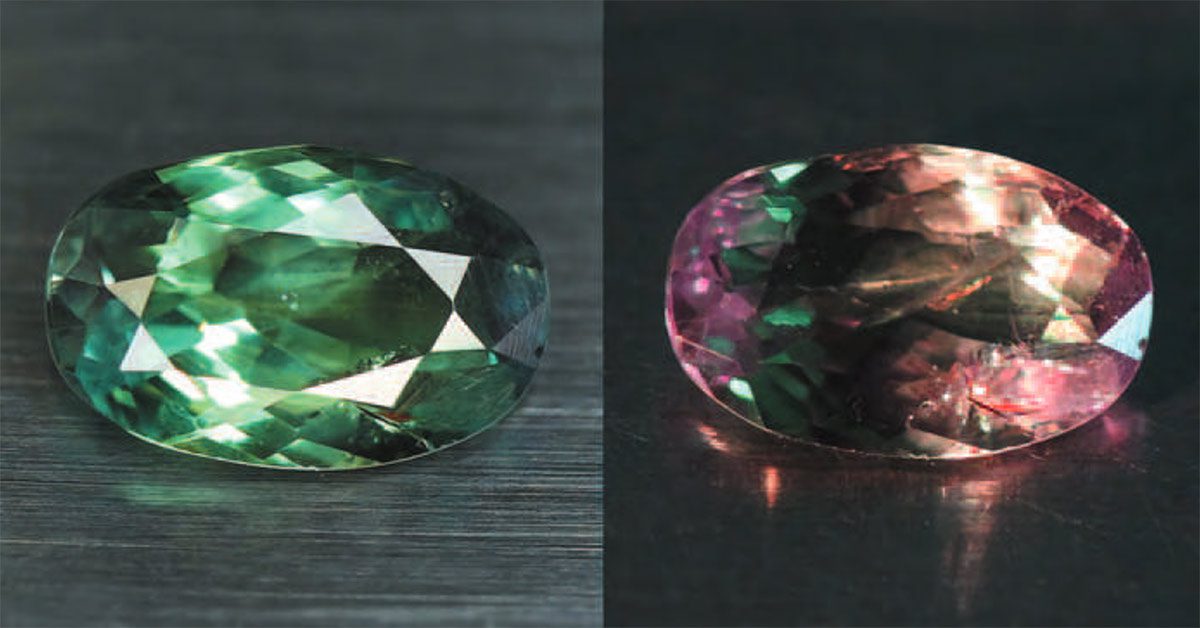
The lady’s ring was made in St Petersburg, making it a pre-October Russian revolutionary jewel. The faceted oval cut colour change alexandrite has small diamonds on either side forming part of the central collet, with beautiful quality cushion cut diamonds flanking the ring set in platinum and 18-carat gold.
The ring is extremely rare and very valuable. The lady went on to explain that it was a gift bought in St Petersburg and given to his wife as an anniversary gift. The lady was raising money to assist with her grandchild’s education fees.
Having purchased the ring, I have sent it to Birmingham’s gemmology centre for further analysis and verification. We are looking forward to having it as part of our window display shortly.